
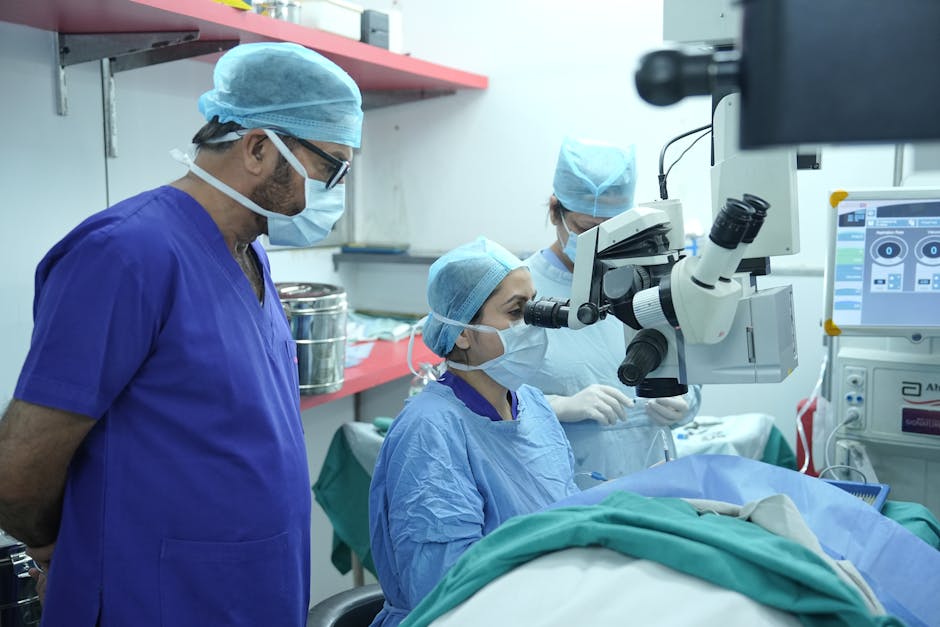
 Photo from Pexels
Originally Posted On: https://bluefinvision.com/blog/lens-replacement-surgery-checklist/
The Essential Checklist of Questions to Ask Before Your Lens Replacement Surgery Consultation
Patients considering lens replacement surgery – also known as refractive lens exchange (RLE) or clear lens extraction – often focus on two things: cost and which premium lens will give them the best chance of reading without glasses.
Both matter. Neither is the most important question.
Refractive lens exchange is one of the most consequential elective procedures available in modern ophthalmology. The natural lens is removed permanently and replaced with a synthetic intraocular lens (IOL) implanted for life. Unlike cataract surgery, which addresses established pathology, RLE is performed on a clear, functioning lens. The indication is entirely refractive: the patient wants to reduce or eliminate their dependence on glasses or contact lenses.¹
This distinction changes the clinical calculus entirely. The tolerance for an adverse outcome, whether a refractive miss, a posterior capsule rupture, or an IOL that is not well-tolerated, is fundamentally different in a patient who elected surgery to improve an already functional visual system, compared with a patient who had no other option.²
Patients undergoing lens replacement are entirely self-funding. There is no insurer to absorb the cost of a complication, no NHS fallback if the premium lens outcome falls short of expectation, and no undo. This makes the selection of a surgeon one of the most consequential decisions in the patient’s clinical journey.
The checklist below is designed to help patients ask the right questions before committing to surgery. Many can be researched before attending a consultation. All should be answered clearly and without hesitation by any surgeon you seriously consider.³
How to Use This Checklist
This document is designed to prepare you for your refractive lens exchange consultation. The consultation is a clinical evaluation, not a sales presentation. You should expect evidence-based, specific answers to these questions.³
Not every patient will need to ask all of them. Those with straightforward prescriptions and no refractive surgery history may find sections 1, 2, and 4 most relevant. Those with a history of previous laser eye surgery, or considering bilateral premium lenses, should pay particular attention to sections 3 and 6.
- Bring this checklist to your consultation
- Review the most relevant sections in advance
- Ask for specific, evidence-based answers to the questions that apply to you
1. Questions About Your Surgeon
In elective surgery performed on otherwise healthy eyes, the surgeon is the single most important variable. The margins for error are narrow. The stakes – permanent alteration of functional vision – are high.
Are you on the GMC Specialist Register for Ophthalmology?
The GMC Specialist Register confirms completion of a recognised UK postgraduate training programme in ophthalmology and eligibility to practise as a consultant. It is publicly searchable at gmc-uk.org.⁴ Lens replacement surgery can be performed in the UK by practitioners who are not on the Specialist Register. Patients should confirm register status before proceeding.
Plain English: Check that your surgeon is a fully qualified ophthalmic consultant, registered with the GMC. Do not assume.
What is your posterior capsule rupture rate on the National Ophthalmology Database?
Posterior capsule rupture (PCR) is the most clinically significant intraoperative complication of lens surgery. The national NHS benchmark sits at approximately 0.87%.⁵ ⁶ In the context of refractive lens exchange – performed electively on younger patients with clearer lenses and more demanding visual expectations – the stakes are considerably higher.
A PCR in an RLE patient carries particular consequences: the patient may be unable to receive the premium IOL they were expecting, may require vitreoretinal surgery, and may end up with a materially worse visual outcome than the one they started with. PCR rates are publicly reportable and benchmarked through the National Ophthalmology Database (NOD). Surgeons operating within well-governed systems should be able to provide their NOD-referenced rate transparently.
Plain English: Ask your surgeon for their actual PCR rate compared to the national average. If they cannot give you a NOD-referenced number, that is itself important information.
Do you personally perform the entire operation?
In some private ophthalmology models, a consultant performs the initial assessment and consent but delegates surgical steps to an associate or trainee. Patients choosing private lens replacement surgery should confirm that the consultant named at consultation performs the entire procedure.³
Plain English: Will the consultant you met perform your surgery from start to finish, or will parts be done by someone else?
What is your annual volume of lens replacement procedures specifically?
Procedure-specific volume matters more than total lens surgery volume. Refractive lens exchange on a 50-year-old with a clear lens and a trifocal IOL demands different expertise than routine cataract surgery on an older patient with dense lens opacity.¹ Ask specifically how many RLE cases – not just cataract procedures – the surgeon performs each year, and whether they have a dedicated refractive lens programme.
Plain English: Ask specifically how many lens replacement procedures – not just cataract cases – the surgeon performs each year.
2. Questions About the Clinic and Clinical System
The outcome of refractive lens exchange depends not only on the surgeon’s technical skill but on the infrastructure surrounding the procedure: diagnostic equipment, complication management protocols, and what happens after the patient leaves theatre.
What biometry equipment do you use, and do you perform dual biometry?
Accurate biometry is the foundation of every lens replacement outcome. The commonest cause of patient dissatisfaction after RLE is residual ametropia – a refractive result that falls short of the target. The majority of refractive misses originate not from surgical error but from biometric inaccuracy in lens power calculation.⁷
Modern best practice involves dual biometry: two independent measurement platforms cross-checked before a lens power is finalised. Some practices also integrate AI-assisted lens selection tools that use all biometric inputs to optimise the IOL recommendation. Ask whether these approaches are used routinely, and, crucially, what the practice’s actual enhancement rate after RLE is. That number is the most direct measure of biometric accuracy in clinical practice.
Plain English: Ask whether dual biometry is used routinely, and what the practice’s enhancement rate after lens replacement actually is.
If a complication such as a dropped nucleus occurs, how will it be managed?
A dropped nucleus – lens fragments falling into the vitreous cavity – requires planned pars plana vitrectomy by an experienced vitreoretinal surgeon. Early, planned vitrectomy by a specialist produces substantially better outcomes than delayed or emergency management.⁸ For RLE patients specifically, a dropped nucleus may mean the intended premium IOL cannot be implanted, potentially resulting in a worse visual outcome than the patient’s pre-surgical baseline.
Ask explicitly whether the clinic has in-house vitreoretinal support, or whether a dropped nucleus would require urgent referral to an external centre.
Plain English: If lens fragments fall to the back of the eye during surgery, who will manage it, how quickly, and within which clinical system?
Will I be referred to the NHS if complications arise?
In private ophthalmology, the management of complications is not uniformly retained within the treating clinic. Where integrated specialist support does not exist, patients may be directed to NHS emergency pathways for complications arising from a private elective procedure. Ask this question explicitly and confirm the pathway for the full range of potential complications, not only routine ones.
Plain English: Does the clinic handle its own complications in full, or will a serious complication require you to go elsewhere?
Is the consultation recorded, and can you obtain copies of your scan data?
Lens replacement is a major elective decision. Patients benefit from a verifiable record of what was discussed – risks, lens choices, refractive targets – to review, share with family, or refer back to before surgery. Some practices record consultations and provide transcripts or footage. Scan data (biometry, corneal topography, OCT imaging) should be available to the patient as part of their clinical record.
Plain English: Is the consultation recorded so you can review what was discussed? Can you obtain copies of your scan data and measurements?
3. Questions About the Refractive Target and Enhancement Policy
Refractive lens exchange patients are not tolerating residual glasses dependence. The refractive target matters more than in cataract surgery, and the consequences of missing it are felt more acutely.
What refractive target will be aimed for in each eye, and how is bilateral targeting managed?
The default target in RLE is emmetropia – zero residual prescription – in each eye. But bilateral targeting is not a simple arithmetic exercise. Small residual differences between eyes that are each individually within a tolerable range may together produce a functional difference that is noticeable to the patient.⁹ A bilateral interocular difference of approximately 1.00 dioptre spherical equivalent is the broadly accepted threshold above which most patients notice a perceptible difference in image quality between eyes.
Practically: a result of plano in one eye and −0.75 in the other, both individually within acceptable limits, may nonetheless be noticed by a patient whose expectation was symmetrical emmetropia. This is a foreseeable outcome that should be discussed before surgery, not explained for the first time postoperatively.
Plain English: What prescription are you aiming for in each eye? How will you manage small differences between eyes, and at what point would an enhancement be offered?
What is your enhancement policy – and does it distinguish between corneal laser and IOL exchange?
Where residual refractive error after RLE warrants treatment, the first-line approach is typically corneal laser surgery – LASIK, PRK, or SMILE performed over the pseudophakic cornea once the refraction has stabilised, usually at three months or later.¹⁰ This is a well-tolerated, reversible option for most patients and should be the default enhancement pathway for spherical and astigmatic errors within the range of laser correction.
IOL exchange – surgical replacement of the implanted lens – is a more complex procedure reserved for cases where the residual error is outside laser range, or where there is a specific IOL-related problem such as persistent dysphotopsia or IOL malposition. Patients should understand which pathway applies to their situation and under what conditions each would be offered.
Enhancement policies vary substantially between providers. Key questions: what is the dioptre threshold at which an enhancement is offered? Is the threshold applied per eye or to the bilateral outcome? Is the enhancement performed by the original surgeon or referred elsewhere? Are the terms documented in writing before surgery?
Plain English: If your vision after surgery is not what was planned, what is the threshold for an enhancement – and will it be corneal laser surgery or lens exchange? Ask to see the terms in writing.
Are enhancement procedures included in the surgical fee, and for how long?
Enhancement policies frequently contain exclusions that are not disclosed at booking – time limits, prescription thresholds, co-existing ocular conditions. Patients should request written enhancement terms before surgery. The absence of written criteria is itself informative.
Plain English: Are enhancement procedures genuinely included, or are there conditions that might mean you are charged again? Ask to see the terms in writing.
4. Questions About Lens Selection
The IOL implanted during refractive lens exchange determines how the eye focuses for the rest of the patient’s life. Lens selection is a clinical decision, not a commercial upsell.
Do you offer the full range of modern IOL types?
Contemporary options include: monofocal lenses (single focus, typically distance), enhanced monofocal lenses (extended near range with reduced spectacle dependence), extended depth-of-focus (EDOF) lenses (continuous distance-to-intermediate vision with low dysphotopsia), trifocal lenses (distance, intermediate, and near), and toric variants of each for astigmatism correction.¹¹ Surgeons who offer only a limited portfolio have a structural incentive to recommend what they have rather than what suits the patient.
Plain English: Does your surgeon offer all the modern lens types, or are you limited to whatever they happen to stock?
Which lens do you recommend for my prescription, corneal topography, and lifestyle – and why?
Lens selection in RLE should be individually calibrated to: corneal astigmatism (magnitude and regularity), anterior chamber depth, pupil dynamics, corneal higher-order aberrations, any previous refractive surgery history, and the patient’s specific visual demands – near, intermediate, distance, driving, and reading.¹²
Generic recommendations by price tier alone are not appropriate. A patient with significant corneal higher-order aberrations may perform poorly with a trifocal IOL that would serve another patient well. A patient who drives professionally at night may be better served by an EDOF design, even if the trifocal offers better uncorrected near acuity.
Plain English: The lens recommendation should be based on your eye measurements, your daily activities, and your visual priorities – not cost tier alone.
What proportion of patients achieve driving-standard unaided distance vision after lens replacement?
A practical way to anchor outcome expectations is to ask what proportion of RLE patients achieve unaided distance vision of 6/12 or better (the UK driving standard) without glasses postoperatively. Published data from well-governed RLE programmes consistently demonstrate rates above 90% for distance vision.¹ ¹² Patients considering premium lenses for spectacle independence should ask for the practice’s own outcome data, not industry figures alone.
Plain English: Ask what proportion of the surgeon’s own patients achieve driving-standard vision without glasses after lens replacement.
What level of glare, haloes, and dysphotopsia should I expect?
Dysphotopsia – glare, haloes, and starbursts around point light sources – is a predictable consequence of diffractive premium IOL optics, most noticeable in low-light conditions. Most patients adapt over three to six months. A small proportion experience persistent dysphotopsia that affects driving or quality of life.¹³
Risk factors include large pupils, corneal higher-order aberrations, and specific lens designs. EDOF designs are generally associated with lower dysphotopsia profiles than trifocals. “You might notice some glare but it usually settles” is not an adequate description – patients are entitled to a calibrated, design-specific discussion of the optical trade-offs.
Plain English: Premium lenses can cause visual effects around lights. Ask how common and how significant these effects are with the specific lens being recommended.
What happens if I do not tolerate the premium IOL?
In a small proportion of patients, dysphotopsia does not resolve with neural adaptation. Before attributing symptoms to the IOL, other causes should be excluded: posterior capsule opacification, residual refractive error, dry eye, and corneal pathology. Where dysphotopsia is confirmed as IOL-driven and persistent, IOL exchange – replacement with a monofocal or EDOF design – is the most definitive option, though it is more complex than the primary procedure.¹⁴ Ask in advance whether IOL exchange is available within the same clinical network and whether it incurs additional cost.
Plain English: If you cannot tolerate the side effects of a premium lens, what are the options, who will manage it, and what will it cost?
5. Questions About Complication Prevention and Postoperative Care
Lens replacement is elective surgery. The clinical system’s responsibility is to minimise the probability of complications and to manage those that occur without transferring clinical or financial responsibility to the patient.
What is your protocol for preventing cystoid macular oedema?
Cystoid macular oedema (CMO) is one of the most common causes of suboptimal visual acuity following otherwise uncomplicated lens surgery. Its incidence is protocol-dependent.¹⁵ Current evidence-based practice recommends combination topical corticosteroid and NSAID drops for a minimum of four to six weeks following surgery, with extended courses for higher-risk patients.¹⁶ Patients should ask what the standard protocol is, how long drops are prescribed, and whether the practice supplies them directly or requires the patient to obtain them separately.
Plain English: Are all postoperative drops included in the fee? If CMO develops and requires extended treatment, who provides the additional medication – and at whose cost?
Are all postoperative drops included in the surgical fee?
Postoperative medication after lens replacement – typically six weeks of topical corticosteroid and NSAID drops – is a clinically meaningful element of the care pathway, not an administrative detail. Practices vary in whether these are supplied directly, prescribed via GP, or invoiced separately. Confirm before surgery how postoperative drops will be provided and whether extended treatment for complications would incur additional cost.
Plain English: Confirm how postoperative drops are provided and whether extended treatment for complications such as CMO would incur additional cost.
How is bilateral surgery managed, and what is the interval between eyes?
Standard practice involves reviewing the first eye before proceeding with the second, confirming refractive result, IOP stability, absence of unexpected inflammation, and patient comfort. The typical interval is one to two weeks, but this is predicated on a satisfactory first-eye outcome.¹⁷ The decision to proceed with the second eye should be a clinical one, not a scheduling one.
Plain English: How long between eyes, and what criteria determine whether it is safe to proceed with the second eye on schedule?
What is included in the postoperative care pathway for late complications?
Late complications – including posterior capsule opacification (PCO) requiring YAG capsulotomy, residual refractive error warranting enhancement, and persistent dry eye – are foreseeable and manageable. Confirm whether YAG capsulotomy is available within the same clinical network, whether follow-up consultations for clinical concerns arising from the procedure are charged separately, and whether the enhancement pathway is accessible through the same surgeon.
Plain English: What happens if something goes wrong weeks or months after surgery? Who manages it, within which clinical system, and at what cost?
6. What the Outcome Data Actually Tells You
Refractive lens exchange is not a commodity. The difference in outcomes between well-governed and less well-governed surgical practices is measurable, benchmarked, and clinically significant. Patients have the tools to access this data.
Posterior capsule rupture rates are publicly benchmarked – and they vary
The National Ophthalmology Database (NOD) collects case-level complication data from participating surgeons and produces risk-adjusted outcome reports. The most recent national NHS benchmark for PCR is approximately 0.87%.⁵ ⁶ Individual surgeon rates, where published through NOD, can sit well below this. A fourfold or fivefold reduction in the rate of the most serious intraoperative complication is not trivial – it represents a meaningfully different level of safety for a patient choosing where to have elective surgery on healthy eyes.
Ask any surgeon you are seriously considering for their NOD-published PCR rate. If they participate in NOD and have a rate substantially better than average, they will be able to provide that figure.
Plain English: Ask for the surgeon’s NOD-published PCR rate. Compare it to the national benchmark of 0.87%. The differential matters more in elective RLE than in almost any other ophthalmic procedure.
Read more about how Blue Fin Vision® benchmarks outcomes.
Enhancement rates reflect biometric accuracy – ask for the number
The enhancement rate after RLE is the most direct measure of a practice’s biometric precision and IOL selection accuracy. A practice using dual biometry and validated power calculation formulae should demonstrate an enhancement rate significantly below 5%.⁷ ¹⁰ Ask for the actual number with a clear denominator.
Plain English: Ask what the practice’s actual enhancement rate after lens replacement is. A low rate reflects biometric accuracy and good pre-operative planning.
Some limitations are the surgeon’s – not yours
Patients with a history of previous refractive surgery – LASIK, PRK, or SMILE – are sometimes told premium IOLs are not appropriate, on the basis that post-refractive biometry introduces uncertainty into refractive outcomes. This caution has a basis: standard IOL power formulas can underperform in post-refractive corneas. However, for surgeons with access to swept-source OCT biometry and validated post-refractive formulae (Barrett True-K, Kane Post-Refractive), premium lenses remain a viable and often preferable option for many patients in this group.⁷
A refusal may reflect the resources and experience available at that centre rather than a clinical contraindication specific to the patient. A second opinion from a surgeon experienced in post-refractive biometry is entirely appropriate.
Plain English: If you have had previous laser eye surgery and are told premium lenses are not suitable, ask specifically why and what biometric tools are being used. A second opinion is appropriate.
7. Questions About Anxiety and Comfort
Refractive lens exchange is performed under topical local anaesthetic drops. Most patients find the procedure more comfortable and less alarming than they anticipated. Anxiety before elective eye surgery is normal and should be managed as part of the clinical pathway, not dismissed.
- What will I see, hear, and feel during the procedure?
- Is oral sedation available if I feel anxious on the day?
- How long does the procedure take per eye?
- Will I be awake for the IOL implantation?
- What should I do if I feel the urge to blink or move during surgery?
Plain English: It is normal to feel apprehensive. Ask exactly what the experience involves and what support is available if you are anxious. Informed patients have a better surgical experience.
Read more about what to expect after lens replacement surgery.
Final Thoughts
Choosing a lens replacement surgeon is a decision with permanent consequences. The natural lens does not grow back. The IOL implanted at surgery will be in place for the rest of the patient’s life. The refractive outcome achieved, or missed, determines the quality of vision that patient will experience for decades.
Patients who ask these questions before attending a consultation are better positioned to assess whether the clinical system being offered matches the standard their decision deserves. These questions are not designed to be confrontational. They are designed to be answered – clearly, specifically, and without hesitation – by any surgeon worthy of the trust that refractive lens exchange requires.
At Blue Fin Vision®, these questions are addressed directly during consultation. Both Mr Mfazo Hove and Professor Mahmut Dogramaci are consultant ophthalmic surgeons on the GMC Specialist Register, and surgical outcomes are benchmarked against the National Ophthalmology Database. Dual biometry, a defined enhancement policy, and access to in-house vitreoretinal support form part of the clinical infrastructure across Blue Fin Vision® sites; specific pathway details are confirmed at the pre-operative assessment for each patient. Further detail on each of these areas is available across the Blue Fin Vision® clinical resource pages.
Read verified patient reviews on the Wall of Love.
Blue Fin Vision® Lens Replacement Surgery Checklist
Questions to Ask Before Lens Replacement
Questions About Your Surgeon
- Are you on the GMC Specialist Register for Ophthalmology?
- What is your posterior capsule rupture rate on the National Ophthalmology Database?
- Do you personally perform the entire operation from start to finish?
- How many refractive lens exchange procedures – not just cataract cases – do you perform each year?
Questions About the Clinic
- Do you use dual biometry, cross-checking two independent measurement platforms?
- Is AI-assisted lens selection used to optimise IOL power calculation?
- What is your practice’s actual enhancement rate after lens replacement?
- If a dropped nucleus occurs, how will it be managed – and by whom?
- Is there in-house vitreoretinal support, or would I be referred to the NHS?
- Is the consultation recorded, and can I obtain copies of my scan data?
Questions About Refractive Target and Enhancement Policy
- What refractive target are you aiming for in each eye, and how is the bilateral outcome managed?
- What is the specific threshold at which an enhancement will be offered – and will it be corneal laser surgery or lens exchange?
- Are the enhancement terms documented in writing, and are there any exclusions?
Questions About Lens Selection
- Do you offer the full range of IOL types – trifocal, EDOF, enhanced monofocal, and toric variants?
- Which lens do you recommend for my prescription, corneal topography, and lifestyle – and why?
- What proportion of your patients achieve driving-standard unaided distance vision after lens replacement?
- What level of dysphotopsia should I expect with my recommended lens?
- What happens if I do not tolerate the premium IOL after surgery?
Questions About Complication Prevention and Postoperative Care
- What is your protocol for preventing cystoid macular oedema, and are all drops included in the fee?
- If CMO develops and requires extended treatment, who provides the additional medication?
- What interval between eyes, and what criteria determine whether the second eye proceeds on schedule?
- What is included in the postoperative care pathway for late complications – PCO, residual error, dry eye?
Questions About Anxiety and Comfort
- What will I experience during the procedure?
- Is oral sedation available if I feel anxious?
References
- Alió JL, Grzybowski A, Romaniuk D. Refractive lens exchange in modern practice: when and when not to do it? Eye Vis (Lond). 2014;1:10. PMID: 26605357.
- Day AC, Donachie PHJ, Sparrow JM, Johnston RL. The Royal College of Ophthalmologists’ National Ophthalmology Database study of cataract surgery: report 1, visual outcomes and complications. Eye (Lond). 2015;29(4):552–560. PMID: 25634513.
- General Medical Council. Consent: patients and doctors making decisions together. London: GMC; 2020.
- General Medical Council. The Specialist Register. London: GMC; 2024. Available at: https://www.gmc-uk.org/registration-and-licensing/the-medical-register.
- Jaycock P, Johnston RL, Taylor H, Adams M, Tole DM, Sparrow JM. The Cataract National Dataset electronic multi-centre audit of 55,567 operations. Eye (Lond). 2009;23(1):10–16. PMID: 18437182.
- Royal College of Ophthalmologists. National Ophthalmology Database Audit for Cataract Surgery. 2023. Available at: https://www.rcophth.ac.uk/news-views/.
- Melles RB, Holladay JT, Chang WJ. Accuracy of intraocular lens calculation formulas. Ophthalmology. 2018;125(2):169–178. PMID: 28951074.
- Vanner EA, Stewart MW. Vitrectomy timing for retained lens fragments after surgery for age-related cataracts: a systematic review and meta-analysis. Am J Ophthalmol. 2011;152(3):345–357. PMID: 21723539.
- Wilkins MR, Allan BD, Rubin GS, Freeman CE, Moorfields IOL Study Group. Randomised trial of multifocal intraocular lenses versus monovision after bilateral cataract surgery. Ophthalmology. 2013;120(12):2449–2455. PMID: 23890162.
- Garg P, Krishna V, Majji AB, Bhavsar AS. Post-cataract refractive enhancement with excimer laser surgery. Indian J Ophthalmol. 2020;68(12):2771–2776. PMID: 33229636.
- de Silva SR, Evans JR, Kirthi V, Ziaei M, Leyland M. Multifocal versus monofocal intraocular lenses after cataract extraction. Cochrane Database Syst Rev. 2016;12:CD003169. PMID: 27943250.
- Auffarth GU, Millán MS, Monastyrskaya EA, Auffarth B, Auerbach FN, Son HS. AT LARA 829MP: clinical and optical outcomes of a new extended depth of focus IOL. J Cataract Refract Surg. 2021;47(2):184–191. PMID: 33196597.
- Masket S, Fram NR. Pseudophakic dysphotopsia: review of incidence, mechanisms, and management. J Cataract Refract Surg. 2011;37(4):707–715. PMID: 21397779.
- Gundersen KG. Intraocular lens exchange after cataract surgery: a prospective study. J Cataract Refract Surg. 2021;47(6):789–796. PMID: 33093399.
- Lobo C. Pseudophakic cystoid macular edema. Ophthalmologica. 2012;227(2):61–67. PMID: 21757976.
- Wielders LHP, Lambermont VA, Schouten JSAG, van den Biggelaar FJHM, Nuijts RMMA. Prevention of cystoid macular edema after cataract surgery in nondiabetic and diabetic patients: a systematic review and meta-analysis. Am J Ophthalmol. 2015;160(5):968–981. PMID: 26209391.
- Arshinoff SA, Bastianelli PA. Incidence of postoperative endophthalmitis after immediate sequential bilateral cataract surgery. J Cataract Refract Surg. 2011;37(12):2105–2114. PMID: 22018368.
ABOUT THE AUTHOR
Mr Mfazo Hove
Consultant Ophthalmic Surgeon
MBChB MD FRCOphth CertLRS
Mr Hove is a consultant ophthalmic surgeon who has performed more than 57,000 procedures. His training includes 6.5 years of specialist development at Moorfields Eye Hospital, followed by five years as a consultant at the Western Eye Hospital (Imperial College Healthcare NHS Trust). He is a consultant at Blue Fin Vision®, an elite ophthalmology clinic serving London, Essex and Hertfordshire, working alongside an experienced clinical team delivering comprehensive ophthalmic care. He specialises in cataract surgery and advanced vision correction, including laser procedures, lens replacement and implantable Collamer lenses (ICL).
Book Your Lens Replacement Consultation
If you are ready to explore whether lens replacement surgery is right for you, book a consultation with the Blue Fin Vision® team. Every patient is assessed personally by a consultant ophthalmic surgeon, with access to dual ZEISS biometry, advanced diagnostics and a clearly defined enhancement pathway. Consultations are available across clinics in London, Hertfordshire and Essex. To discuss your suitability and ask the questions that matter most, contact Blue Fin Vision® today.
